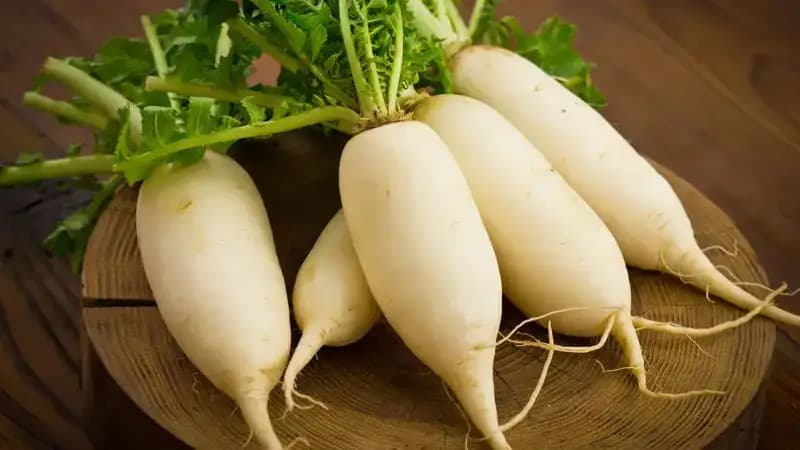
Explore the numerous health benefits of white radish, a nutritious root vegetable. This guide provides essential information on the nutritional value of white radish and how it can support a healthy lifestyle.
Frequently Asked Questions
How is mooli (white radish) traditionally used in Indian cooking — and does cooking reduce its nutrition?
Mooli (Raphanus sativus) is one of the most nutritionally dense and underutilised winter vegetables in Indian cooking. It is naturally high in Vitamin C (25mg/100g), folate, fibre, and glucosinolates — a class of sulphur-containing compounds with proven anti-inflammatory and potential anti-cancer properties. Common traditional Indian preparations and their nutritional profiles: Mooli ka paratha: grated mooli + whole wheat atta — a complete breakfast with 300-350 kcal, 8g protein, 6g fibre per paratha; glucosinolates partially survive cooking. Mooli ki sabzi: stir-fried with tadka (hing + jeera + turmeric) — quick, low-calorie side dish (80 kcal per serving). Mooli raita: grated raw mooli + curd — retains maximum glucosinolates; probiotic from curd; excellent digestive combination. Mooli achar (pickle): fermented mooli — preserves glucosinolates, adds beneficial bacteria, though sodium is high (limit if hypertensive). Muli soup (North Indian winter dish): mooli boiled with ginger and black pepper — traditional remedy for respiratory congestion (anecdotal but consistent with glucosinolate mechanism). Does cooking reduce nutrition? Heat partially degrades Vitamin C (30-50% loss) but does not significantly reduce fibre, folate, or mineral content; glucosinolates are partially hydrolysed during cooking but myrosinase activity is also deactivated — the net bioavailability of isothiocyanates (the active anti-cancer compounds) from cooked vs raw mooli is studied but not definitively resolved. Raw mooli (in raita or salad) likely delivers more active glucosinolate-derived compounds. Mooli greens (leaves): often discarded but rich in iron, calcium, Vitamin A — can be used in dal or sabzi.
I have a thyroid condition — is mooli safe to eat, or should I avoid it because of goitrogens?
This is a valid and common concern in India. Mooli contains glucosinolates, some of which can act as goitrogens — compounds that interfere with iodine uptake by the thyroid, potentially suppressing thyroid hormone synthesis. Evidence on goitrogenic risk: the goitrogenic effect of cruciferous vegetables (including mooli/radish) is real but modest, and is significantly reduced by cooking. Raw mooli consumed in very large quantities (500g+ per day) over an extended period in someone with marginal iodine intake could theoretically worsen subclinical hypothyroidism. Realistic dietary amounts (50-100g per day) pose minimal risk for most thyroid patients. Cooking guidance: boiling or steaming mooli for 5-10 minutes hydrolyses ~60-70% of goitrogenic glucosinolates — mooli sabzi, mooli soup, or paratha filling is much safer than raw mooli kachumber or juice for thyroid patients. Key interaction — levothyroxine timing: if you take levothyroxine (Eltroxin, Thyrox), take it 30-60 minutes before breakfast on an empty stomach; high-fibre foods including mooli, if eaten within 30 minutes of levothyroxine, can reduce absorption by 10-30%. Separation of levothyroxine from fibre-rich foods by 1 hour is the clinical recommendation. Safe mooli consumption for hypothyroid patients: cooked mooli (sabzi, paratha, soup): 100-150g per day is generally safe with adequate iodised salt intake; raw mooli (raita, kachumber): limit to 50-75g per day; mooli juice: exercise caution — high concentration of raw glucosinolates in a concentrated form; discuss with your endocrinologist if you have severe or newly diagnosed hypothyroidism.
Is it true that mooli (white radish) is good for the liver and helps with jaundice — what does the evidence say?
The belief that mooli benefits the liver and helps treat jaundice (piliya) is widespread in Indian traditional medicine (Ayurveda and folk medicine) and has genuine preliminary scientific support. What traditional practice claims: mooli ka ras (fresh juice) is traditionally given to jaundice patients — typically 50-100ml of fresh mooli juice daily during acute jaundice recovery. What the science shows: glucosinolates and isothiocyanates in mooli (particularly 4-methylthio-3-butenyl glucosinolate, glucoerucin, and gluconapin) are hepatoprotective in animal models — they activate Nrf2 pathway (which protects hepatocytes from oxidative damage) and stimulate bile production, which aids bilirubin elimination. A 2011 study (Journal of Ethnopharmacology) on mooli extract showed significant reduction in serum bilirubin in jaundiced rodent models. Human clinical evidence: limited — no well-powered RCT exists specifically for mooli juice in human jaundice. Evidence grade: GRADE C (consistent preclinical evidence; coherent mechanism; no controlled human trials). Practical guidance for jaundice patients: mooli juice as a traditional supportive therapy for viral hepatitis recovery (jaundice phase) is a reasonable low-risk complementary measure — but ONLY under medical supervision, as jaundice can be caused by conditions (hepatitis, haemolysis, cholestasis, liver failure) requiring different management. Do not delay or substitute medical diagnosis for mooli juice alone. Mooli for general liver health (non-jaundice): regular dietary mooli consumption may support bile flow and hepatic detoxification pathways — consistent with the glucosinolate mechanism. Include in diet as a preventive food, not a treatment.
Can diabetics eat mooli — is it safe for blood sugar, and how much per day?
Yes — mooli is one of the most diabetes-friendly vegetables available in India, particularly in winter when it is most widely available and affordable. Glycaemic profile: mooli GI: approximately 15 (very low — one of the lowest GI vegetables); mooli GL per 100g: approximately 1 (negligible — excellent for blood sugar management). Why mooli is excellent for T2D: very low carbohydrate density (3.4g carbs per 100g); high fibre (1.6g per 100g) — slows gastric emptying and glucose absorption; glucosinolates and isothiocyanates have demonstrated anti-diabetic properties in preclinical studies — improved insulin sensitivity and inhibition of α-glucosidase (the same mechanism as acarbose, a diabetes medication). No meaningful upper limit for T2D patients: mooli can be eaten in generous quantities (150-200g per meal) without concern for blood sugar impact — it is filling, low-calorie (16 kcal/100g), and has a favourable satiety response per calorie. Best diabetic preparations: mooli sabzi (cooked, minimal oil) — 80 kcal per serving; mooli raita (plain curd + raw mooli + jeera) — ~100 kcal, excellent protein + probiotic combination; mooli soup (winter) — warming, 50-60 kcal per bowl. Preparations to be aware of: mooli paratha — high in whole wheat carbs (350+ kcal) — counts as a main carbohydrate serving, not a free vegetable; mooli ka paratha with ghee can be 400-450 kcal — plan accordingly in T2D meal plan. Winter availability: mooli is cheapest and most nutritious in October-February across India — T2D patients should actively increase mooli intake during this season.
Questions About This Article
Have a question? Ask the author directly.
Have a question about this article?
Ask Zocvi Editorial directly. Your question may help others with similar concerns.


Comments (0)