
Introduction
Malaria remains a significant public health challenge in many parts of the world. Accurate diagnosis is crucial for effective treatment and control of the disease. Various diagnostic tests are available, each with its own advantages and limitations. This comprehensive guide explores the different diagnostic tests for malaria, detailing their methods, accuracy, and appropriate applications.
Overview of Malaria
Malaria is caused by Plasmodium parasites, with Plasmodium falciparum, P. vivax, P. ovale, and P. malariae being the species that infect humans. The disease is transmitted through the bite of infected female Anopheles mosquitoes. Symptoms of malaria include fever, chills, headache, muscle pain, and in severe cases, anemia, jaundice, and organ failure. Early and accurate diagnosis is essential for effective treatment and preventing complications.
Microscopy
Microscopy remains the gold standard for malaria diagnosis due to its ability to identify the species and quantify the level of parasitemia.
Light microscopy involves examining stained blood smears under a microscope. The two types of blood smears are thick and thin smears. Thick smears are more sensitive for detecting low levels of parasitemia, while thin smears help in species identification.
1. Light Microscopy
Giemsa stain is commonly used for staining blood smears. It highlights the parasites within red blood cells, allowing for visualization and identification.
2. Staining Techniques
Advantages of microscopy include its ability to provide detailed information about the parasite species and density. However, it requires skilled personnel, high-quality reagents, and proper maintenance of microscopes.
3. Advantages and Limitations
Rapid Diagnostic Tests (RDTs)
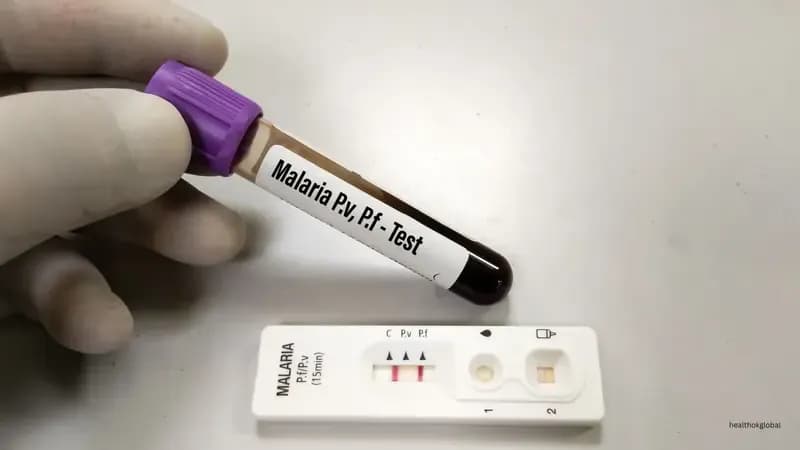
Rapid diagnostic tests (RDTs) provide a quick and easy method for diagnosing malaria, especially in remote and resource-limited settings.
RDTs work by detecting specific antigens produced by malaria parasites. A drop of blood is applied to the test strip, which contains antibodies that bind to the antigens. A visible line indicates a positive result.
1. Principle
Different RDTs target different antigens, such as histidine-rich protein 2 (HRP2) for P. falciparum and Plasmodium lactate dehydrogenase (pLDH) for all species.
2. Types of RDTs
RDTs are user-friendly, provide rapid results, and do not require extensive training or equipment. However, their accuracy can be affected by factors such as antigen variability, cross-reactivity, and storage conditions.
3. Advantages and Limitations
Polymerase Chain Reaction (PCR)
Polymerase chain reaction (PCR) is a molecular technique that amplifies the DNA of malaria parasites, allowing for highly sensitive and specific detection.
PCR involves extracting DNA from a blood sample and using specific primers to amplify parasite DNA. The amplified DNA is then detected and analyzed.
1. Principle
Different types of PCR include conventional PCR, real-time PCR, and nested PCR. Each type varies in its methodology and application.
2. Types of PCR
PCR is highly sensitive and can detect low levels of parasitemia. It can also identify mixed infections and drug resistance markers. However, it requires specialized equipment, trained personnel, and is more expensive and time-consuming compared to other methods.
3. Advantages and Limitations
Loop-Mediated Isothermal Amplification (LAMP)
Loop-mediated isothermal amplification (LAMP) is a molecular technique that allows for rapid and sensitive detection of malaria parasites.
LAMP amplifies DNA at a constant temperature, eliminating the need for thermal cycling. It uses a set of primers and a DNA polymerase to produce large amounts of DNA from a small sample.
1. Principle
LAMP is faster and simpler than PCR, making it suitable for field settings. It provides results in less than an hour and does not require sophisticated equipment. However, it still requires some level of technical expertise and proper handling to avoid contamination.
2. Advantages and Limitations
Serological Tests
Serological tests detect antibodies produced in response to malaria infection. These tests are useful for epidemiological studies and identifying past infections.
Serological tests detect specific antibodies in the blood that are produced in response to malaria parasites. Common methods include enzyme-linked immunosorbent assay (ELISA) and indirect immunofluorescence assay (IFA).
1. Principle
Serological tests are useful for detecting past infections and for epidemiological surveillance. However, they are not suitable for diagnosing acute infections because antibodies can persist long after the infection has been cleared.
2. Advantages and Limitations
Other Diagnostic Methods
Several other methods are being developed and tested for malaria diagnosis, including biosensors, microfluidic devices, and next-generation sequencing.
Biosensors use biological molecules to detect malaria antigens or DNA. These devices offer the potential for rapid, sensitive, and portable testing.
1. Biosensors
Microfluidic devices manipulate small volumes of fluids to detect malaria parasites. These devices are being developed to provide rapid and accurate diagnosis at the point of care.
2. Microfluidic Devices
Next-generation sequencing (NGS) can provide comprehensive data on the genetic makeup of malaria parasites, including drug resistance markers. While still in the research phase, NGS has the potential to revolutionize malaria diagnostics.
3. Next-Generation Sequencing
Comparing Diagnostic Methods
Each diagnostic method has its own strengths and limitations, making them suitable for different contexts and purposes.
Microscopy and PCR are highly specific, while RDTs and LAMP offer a good balance of sensitivity and simplicity. Serological tests are less specific for acute infections but valuable for epidemiological studies.
1. Sensitivity and Specificity
Microscopy and RDTs are cost-effective and suitable for low-resource settings. PCR and NGS are more expensive and require specialized equipment, making them suitable for reference laboratories.
2. Cost and Resource Requirements
RDTs and LAMP provide rapid results, while microscopy and PCR require more time for sample preparation and analysis. NGS offers detailed information but has the longest turnaround time.
3. Turnaround Time
Choosing the Right Diagnostic Test
The choice of diagnostic test depends on various factors, including the setting, available resources, and the purpose of the diagnosis.
In clinical settings, rapid and accurate diagnosis is essential for timely treatment. RDTs and microscopy are commonly used in these settings due to their quick turnaround time and reliability.
1. Clinical Setting
In field settings, where resources are limited, RDTs and LAMP are preferred due to their ease of use and minimal equipment requirements.
2. Field Settings
For research and surveillance, PCR and NGS provide detailed information on parasite genetics and epidemiology, making them valuable tools for tracking drug resistance and infection patterns.
3. Research and Surveillance
Conclusion
Accurate and timely diagnosis of malaria is crucial for effective treatment and control of the disease. Each diagnostic method has its own strengths and limitations, making them suitable for different contexts and purposes. By understanding the various diagnostic tests available, healthcare providers can choose the most appropriate method for their specific needs, ensuring the best outcomes for patients and communities.
About Zocvi
Zocvi connects patients with verified doctors and evidence-based health guidance. Visit zocvi.com or reach us on WhatsApp at +91-92724-57637.




Comments (0)